
AIES Seminar: Data-Driven Healthcare: Empirical Encounters with Computational 'Intelligence'
Location
High School Yards, The University of Edinburgh High School Yards Classroom G.01 Edinburgh EH1 1LZ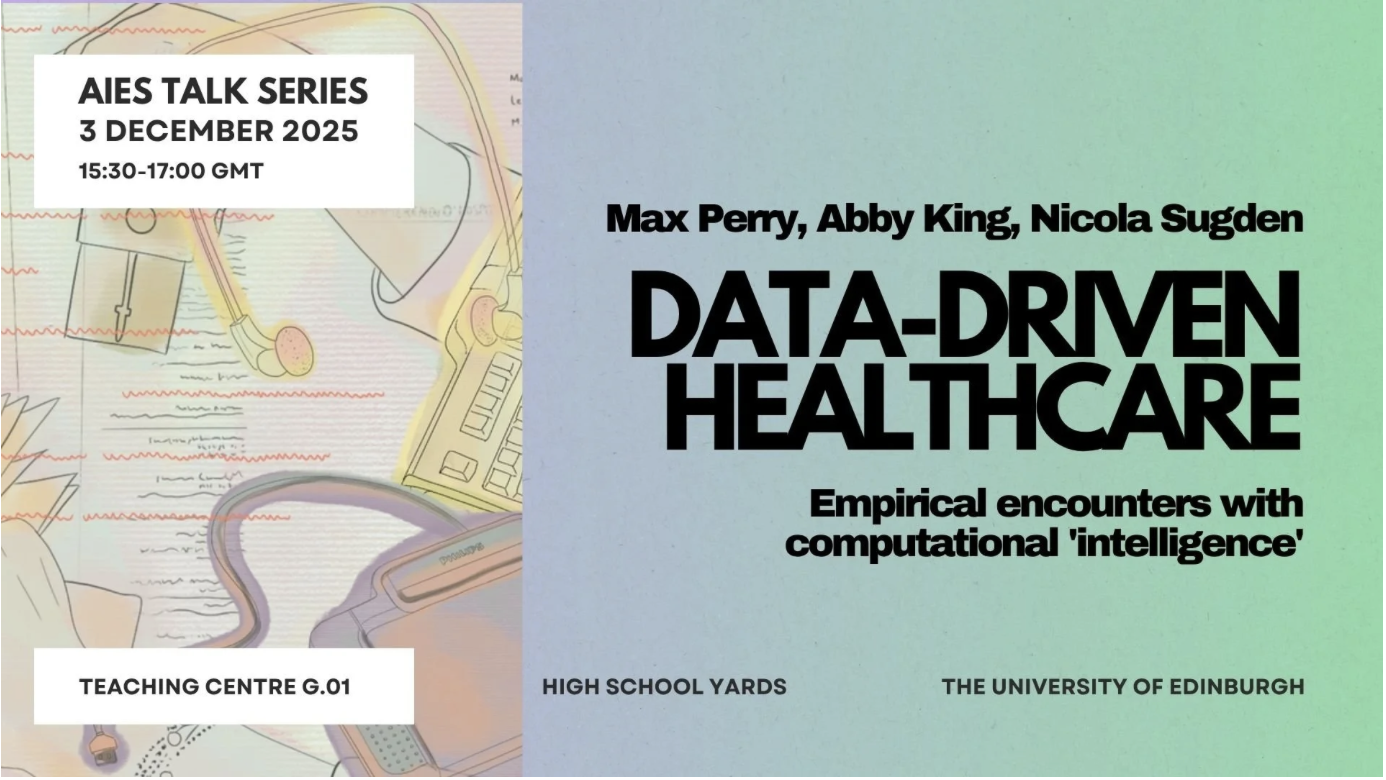
In December, members of the DARE team (Abby, Max, Nicola) will be presenting at the AI, Ethics and Society Talk Series (https://www.ai-ethics.org). Team members will be reflecting on the spectre of 'AI' has haunted their empirical field work.
In December, members of the DARE team (Abby, Max, Nicola) will be presenting at the AI, Ethics and Society Talk Series (https://www.ai-ethics.org). Team members will be reflecting on the spectre of 'AI' has haunted their empirical field work. Full abstract, and event link below.
DARE Project - Data-Driven Healthcare: Empirical Encounters with Computational 'Intelligence' (REGISTER)
Contemporary healthcare systems across the globe are looking to data to resolve problems. Aging populations, human error, efficient allocation of resources, and keeping workers healthy in an increasingly pathological environment are social and political problems. Governments, industry, public organisations and academic institutions are, with growing frequency, looking to the better/proper/skilful use(/computation) of data to ameliorate them.
In this talk, three researchers (Abby, Nicola and Max) from the UKRI funded DARE research project, will give empirical accounts of the ways that data is being used in UK healthcare and biomedical research. Abby, Nicola and Max will present dispatches from their fieldwork, each working across different scales of attention, they will describe how data is being transformed into ‘intelligence’. In turn, they will discuss the ways healthcare and informatics are reshaping each other.
DARE has not made ‘artificial intelligence’ an object of its empirical work, indeed, the researchers are sceptical of the term. However, it is not only objects that cast a shadow. This talk will discuss the ways the researchers have been forced to reckon with AI. Particularly vis-à-vis the methods and modes through which biosocial activities are rendered as data points for computation, as well as how certain logics of intelligence suppose computation as uniquely virtuous when contrasted with other forms of knowing. The talk thus reflects on how we learn about the health of ourselves and others, the implications of this learning for care; and the potential futures for computational intelligence in healthcare.