TALK || The social conditions of possibility reading medical records as documents of practice
Last week, I presented a short talk at a book launch for 'Using Documents in Research'. The talk discusses some of my motivations for the chapter that I wrote in that book, particularly I focused on the philosophy of doing social science research, and the attempt to identify the social properties of an object of research. In many ways, it contains the scattered, slightly unorganised remains of my thinking on the philosophy of social science for which I owe a debt to Leonidas Tsillipakos who I studied under during my MSc in Bristol.
I am posting the text in full here for two reasons:
(1) I think it provides a useful insight into the underlying philosophical and ethical commitments of my fieldwork in the DARE project.
(2) In writing the chapter, and giving the talk, I was reminded about how much of the current methods literature concerns didactic tools that focus on the practicalities of research: what your sample size should be, how to conduct and interview, how many interviews to conduct, etc. (all of which, I am sure, are profoundly useful to many). For my own part, the methodological literature that has provided the most robust support to my work has concerned first-and-foremost questions about what it means to know a thing. This post, my talk, and the accompanying chapter represents a humble attempt to contribute just a small drop into the pool of DARE did, but what it thought it was doing.
Full text, with slide images below.
Max
Hello,
First of all, thank you to Helen and Aimee for inviting me to be part of this book, and for inviting me to speak today.
So, I’m going to talk a little, about how I got involved in the project, in so doing, I hope we can isolate some of my own prior interests and see how they shaped the chapter, and at the end, I’ll briefly provide some account of the main substance of the chapter.
*slide*
I finished my PhD in Bristol in 2024. During that PhD I shared supervisors with the fantastic Policy Press editor Paul Stevens who is writing his own fascinating phd. Paul, through our connection and knowing that I had written a PhD on medical records, advised Helen and Aimee to send the call to me.
Now, I suppose, I had some initial concern about this. Although I basically spent all of my time writing and thinking about documents; I wasn’t sure that I had much to say about the methods of using documents. None the less, I sent a short pitch to Aimee and Helen outlining what would become this chapter. I was emboldened by a certain nihilism that is afforded to those with low expectations and so I suggested that I write a “philosophically inclined reflection on how social scientists make knowledge claims from the use of documents”.
In some ways, all of this was pretention. Of course, writing about ‘making knowledge claims’ is just writing about methods; However, I do think there is a need for more methodological literature that engages deeplywith what it is to claim to know something, and particularly, for us social scientists to think long and hard —and to write clearly and frequently— about the nature of our own knowledge.
That is what I am attempting in the chapter. I quickly want to add that I know this a humble endeavour. I do knot want to claim novelty or profound wisdoms, I just want to guide people towards a particular critical relationship with documents vis-à-vis their sociality.
*SLIDE*
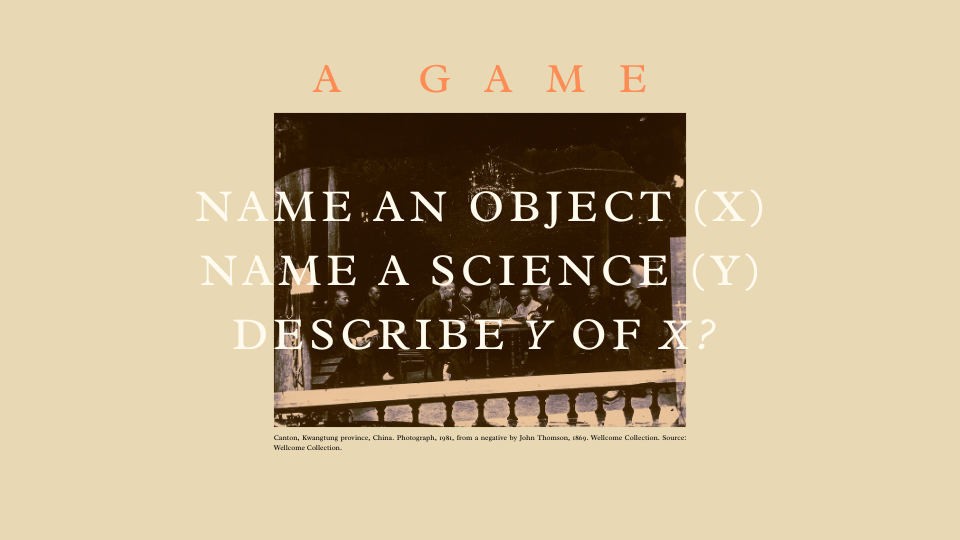
To elaborate on the chapter itself, I’m first going to talk about a game I often play when teaching with first year sociology students. The game starts by me and the students all naming objects, and then, in turn, we speculate on how different sciences might study each object.
The game is a tool to help us to think sociologically and my intention was always to get the students, in this context, to think about what was specific about social scientific enquiry.
Briefly, together I’d like us to play this game, imagining that someone had made their object a “document”.
Let’s first think about a mathematician’s approach, to approach a document mathematically, we might think about it in terms of its dimensions; we might then think about abstracting how many sheets it would take to build a structure as tall as the Eifel tower (these are all quite basic questions for a mathematician, I’m sure). Now let’s think about a chemist; they might be interested in the surface chemistry that shapes the relationship of ink to paper. Now a linguist, who might be interested in the properties of the language deployed on the paper. And on and on…
Now, when we get to the social scientist, we need to start to isolate some questions about the document that concern something different to those other disciplines; something regarding its ‘sociality’. I will give some more profound examples of this later, but let’s for now keep things simple. Let’s imagine the document is a basic administrative form like a job application, a sociologist might be interested to ask why certain questions become more important than others to a bureaucracy. Why is disability reported but under promise of anonymity in a job application? Why does a pub need to record an employees passport numbers?
Clearly, such questions are not —superficially at least— particularly complicated to answer. But then again, neither were those of the mathematician, chemist, and linguist.
*SLIDE*
So far, I haven’t taken us very far. This is a fairly simple first step in doing research. My intention, in taking so long to bring us just this little way, is that I think it is that first step that provides such a profound barrier to social research when using documents. For those scientists that have lab equipment, certain precise and clear operations, or —like mathematics and linguistics— a language and object (numbers and words) so clearly defined, this first step is made easier.
For us social scientists, precision is more easily lost as our laboratories are more porous, and our hold over our objects of study is less well established.
*SLIDE*
What I want to suggest is that we consider not the causality of a document (“what made it”), but instead, locate its social conditions of possibility —and that this is a distinct, and a precise and scientific engagement. Let me, as promised, provide a slightly more detailed example from the chapter.
*SLIDE*
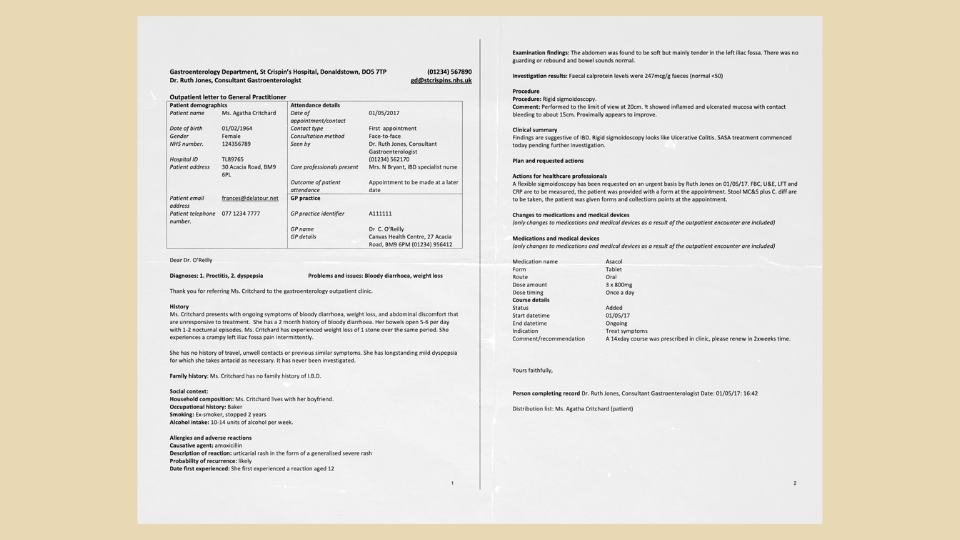
Here, is an outpatient clinic letter which I refer to in the chapter. I could talk about these for hours, but for now, let me just say they are letters that are written after an appointment with a specialist. This one is from a gastroenterology appointment (it’s actually, a totally fabricated letter, used for training purposes but let’s ignore that for now). After a gastroenterology appointment, a doctor will, one way or another produce a letter that looks like this. A copy will be filed in the notes, another will be sent to the patient’s local GP, and a third will be sent directly to the patient.
*SLIDE*
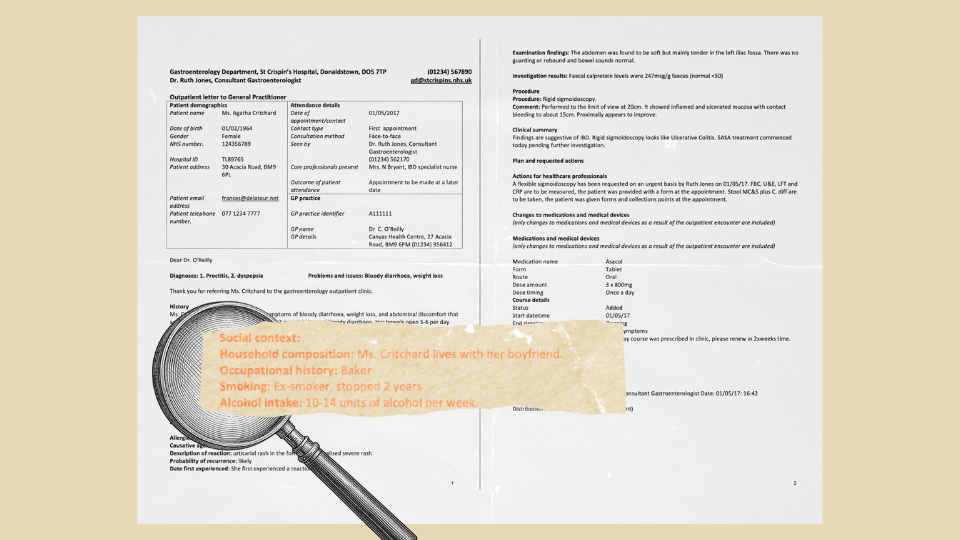
So, let’s just take one question, that I write about in the chapter. “Why is smoking considered an important routine statistic to record but, for example, ‘exercise tolerance’ is not?”. There is a temptation to regard this as a clinical question. However, it is only clinical in its causality; to understand its conditions of possibility in total, a sociologist is needed as well.
So how might we isolate some social conditions of possibility? We might start by saying smoking might be important in some cases, but not all, but here we can see that smoking status is always recorded. Couldn’t we trust a doctor to ask about, and record it if it is important to the case? Indeed doesn’t the NHS know who smokes because this fact is already recorded by a GP? Why, if smoking is a clinical matter, is it (and alcohol intake) recorded in a ‘social history’ section? And why does this section not also record how much exercise a person does, or how much sugar and fats they eat all of which can be equally important clinical facts in diagnoses and treatment.
I hope we can see that I am starting to amass all manner of interesting sociological questions regarding healthcare. I don’t want to answer these questions here, but hopefully we can agree that there are certain social problems in the document that we might try to face down, that might otherwise be left alone as ‘clinical’ in nature.
*SLIDE*
So, I have talked a lot, and we have only taken two very small steps. To say social science is different to mathematics in some ways, but that different scientific enquiry can be pointed at any object (including documents) productively.
So to try to take a bigger step, I want to offer three thoughts which are central to the chapter and emerge from the small steps we have taken thus far.
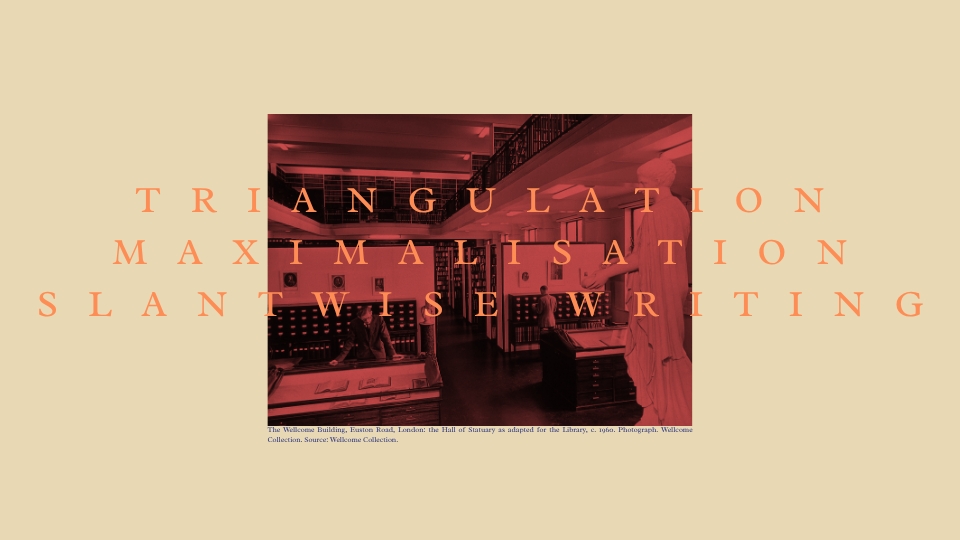
In pursuing this way of asking social questions of documents, I offer three ethics which might help guide us: triangulation, maximalisation, and slantwise writing.
By triangulation, I mean how we contextualise the document. The document cannot just be understood as a self-evident fact, it must be placed into a context of social practice. The outpatient letter must be understood as a bureaucratic form, something with an organisational history, a certain politics, a technical and material reality in the clinic, a set of audiences (doctor, GP, patient) etc. etc.
***
By maximalisation, a term I borrow from Paul Feyarbend, I mean that a social scientist should look for as many connections as possible, follow as many avenues as they can, and leave nothing cordenered off to some ‘other’ way of knowing. That is, if the mathematician is interested in the dimensions of a document, that is all very good, but a sociologist might still be interested to enquire about how standardisation happened around the particular dimensions of A4 paper. They might ask what relationships between printers, people, work, and reading meant that this, slightly bigger than book page size became the one for almost all bureaucratic documents…
To quote Feyarbend: ‘A scientist who wishes to maximise the empirical content of the
views he holds and who wants to understand them as clearly as he possibly can
must therefore introduce other views; that is, he must adopt a pluralistic methodology.’
(Feyerabend, 2010 p 13, emphasis in original).
***
Finally then, I offer ‘slantwise writing’ a term I borrow from Louise Amour who used it in a longer essay about Foucault and Parhassia. Amoor is following a particular argument about critique that I shan’t discuss too much here, but she suggests that we should allow ourselves as researchers to take up strategic vantage points, to elucidate some series of things, and then, step away from that vantage and pursue a new avenue.
I like it, because it calls back to the game I talked about earlier. It is to accept that a sociological enquiry into a document is a strategic position taken. Indeeed, even within this sociological position, many different vantages can be taken. To write slantwise is to avoid totalising the object, to allow room for those other folk —mathematicians, chemists, physicians, linguists, historians, hell even ecconomists— to have their say.
We write slantwise, in such a way that we can cut into something, but without claiming some ownership over the object itself.
Those are the things I hope one can take away from the chapter. Thank you for listening, and I look forward to the discussion.