
DARE at the European Association for the Study of Science and Technology (EASST) Conference 2026
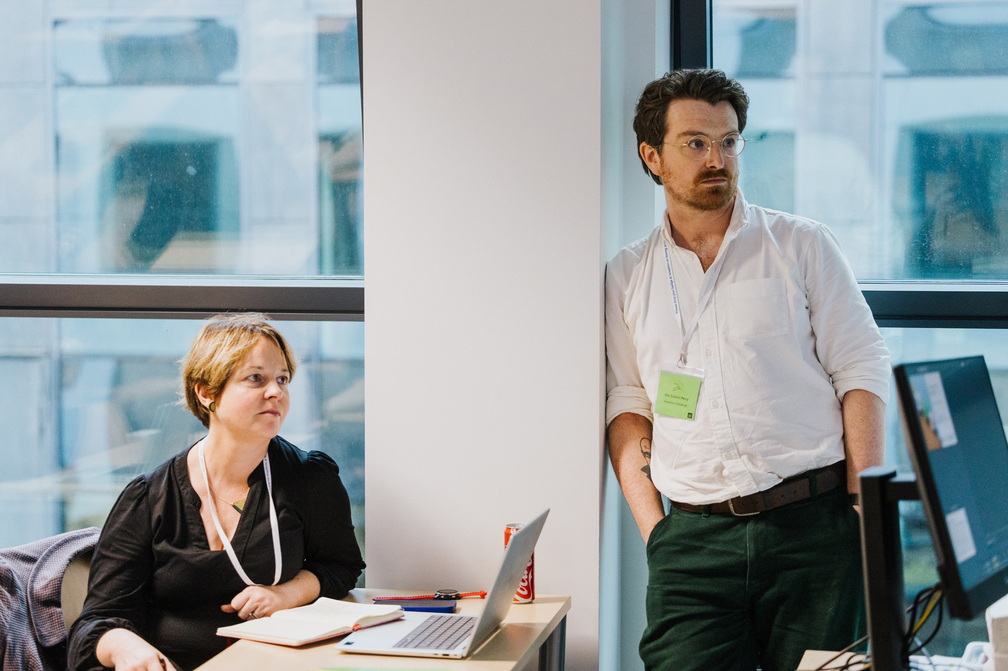
It was 30 degrees in Krakow on the first day of the European Association for the Study of Science and Technology (EASST) conference 2026. To me it seemed unseasonable. Unseasonable in the way that much of the weather over the last year or so has; an all too visceral portent in the present, of a future which is likely to be disrupted by climate change. Such things: portents, present and future defined my time in Krakow. Leaving them aside for now, we (myself, Cath, and Abby) who made up the DARE contingent visiting Poland for the biggest European conference for the field of ‘science and technology studies’, had not properly packed for this unseasonable weather. We were all going to spend a few days too hot. Despite inappropriate clothing, Krakow was beautiful in the sunshine. Because of that beauty, I was grateful that the conference included so many great colleagues and so many interesting discussions such that it did not feel like such a terrible burden to place oneself in a university classroom when we could have otherwise been exploring the markets in Nowy Square or drinking one of the many fine and cheap pilsners on the riverside. Luckily, in those first few days, the sunshine held well into the evening and I could enjoy those things after work, when my heavy cotton twill suit seemed a little more appropriate.
The conference was organised around the theme “More than now: Exploring resilient futures”. As far as such themes shape conferences, to me (and perhaps only me) it inflected the panels with questions that concern the politics of ‘us’ researchers (what should we do?), the politics of life (what is science and technology doing?), and reflections on method (how should we go about understanding events and technologies that seem to move so quickly?). At least that was my sense of it, if Science and Technology Studies is a discipline (and indeed, as the plenary sessions would discuss, such things should not be taken for granted), it is a discipline that is wrestling with how it should respond to the current moment. At EASST, the challenge was to do that by going beyond the present.
Perhaps it was merciful that on Friday the temperature had dropped and the rain had come. The DARE team had organised three panel sessions which ran from 9am until 3.30pm under the title Caring for the Possible: In the Meantime of Healthcare’s Data-Driven Futures. Either the rain or some other pleasant concurrence meant that, a panel on ‘data-driven healthcare’ on the last day of a four-day conference felt remarkably vibrant and generative. That was my sense at least. I hope the panelist and the audience found it so too. They seemed to. It was, I think, good.
Across three sessions we heard ten excellent papers. Papers which probed data-driven healthcare, temporality and ‘the meantime’. In the DARE project, we spend a lot of time hearing and reading about the future of healthcare once we are done with its messy present. That is, each of us is in some way engaged with a field site that wants to deliver a new style of healthcare, more remote, more precise, more prescient, or more efficient. Yet, technologies, science and thought always remains stubbornly moored in the now. The meantime for us was a way of trying to think about this combination of present and future: the more than now. You can read the full panel call here, which includes a better and fuller description of ‘the meantime and includes its intellectual lineage.
However, in truth, the panel didn’t belong to us. It belonged to the presenters, and each of them probed the now, the future, and the meantime in different ways across different contexts and through different methods. Our first session opened with Amelie Lang, who had previously spent some time as a visiting fellow in Edinburgh with us in the DARE project. Amelie talked about her work on pain assessment, and the relationship between a imagined and impossible objectivity in computerised pain assessment and the pragmatics of the researchers charged with delivering it. Marion Coville then discussed menstrual tracking apps, with rich ethnographic detail regarding how researchers live with incomplete datasets. And Gigi Vissers presented work on remote home monitoring, and the nurses charged with making such systems work.
In the second session, our Edinburgh colleague Carolina Mayes examined genomic screening, talking beautifully about the inherent tensions between ‘screening’ and ‘diagnosing’, between ‘patient’ and ‘potential patient’, between positive findings and negative findings ‘for now’.
Continuing a theme of genomic medicine Veena Vijayan A. V. discussed how clinicians in navigate uncertain genetic test results whilst “waiting for a stable knowledge system”. Marjo Kolehmainen then introduced a "digital hauntology" framework to describe how victims of a Finnish psychotherapy data breach live in continuous fear of endlessly circulating data. Finally, Silja Vase and Benjamin Lipp discussed speech recognition and the seemingly sisyphean project of transformation, characterised by promised software updates and ‘precarious maintenance’ of present arrangements.
In the final session, we welcomed another Edinburgh colleague, this time PhD researcher Tyler Harvey, who discussed his ethnographic work with a patient feedback tool focusing on the ways that deeply personal, subjective experiences are transformed into technocratically legible prompts for action — what he described as ‘from phenomenological to institutional’ transformations of patient voice. Eva Sophia Steinberger and Axel Kiehn then presented an exploration of ‘the lighthouse’ as metaphor for digital transformation in Saxony-Anhalt. In my notes I wrote about how beautifully symphonic the presentation was, Eva and Axel weaved their work together in a way I would like to try to cultivate in my own partnerships and cowriting endeavours. The duet was capped with a fascinating post-talk discussion about the value of metaphor and the potential of a metaphor of ‘mining’ or —as suggested in the room— of ‘farming’ as a complement or contrast with ‘the lighthouse’. It was nice, at such a late point in the day and conference, to be in a room talking about such things. The very last presentation was delivered excellently by Jonas Jörg Neubert who works on the European Health Data Space project, a project that shares a kin-like relationship with our own and one that we look forward to exchanging more ideas with in the near future. Jonas’ talk was of great interest to me as it opened with a provocation regarding the invisible utility of ‘standardisation’ explored through railway track and carriage standardisation. Such utility was then contrasted with a drive for standardisation in prescribing across the EU member states in which the ‘use case’ appears altogether less clear.
In part, this blog was an attempt to think about how each of these talks dealt with the ‘more than now’, with ‘the meantime’. I had, in my head, an idea about how it would all come together. Alas, as with all things, once I started writing things drifted, I saw that a vague sense of something is very different from making it concrete and present. That, I guess is the meantime, the work we do whilst imagining a future. Instead of trying to tie things together then, instead of trying to build into the future, I’ll end with the past. Having a pilsner on a beautiful Krakow evening; sat waiting for colleagues and friends; waiting to talk to them about our work in a way that belays how fond I am of it. That was nice. I look forward to next time. For now…
(Photo credit: Kamil Kożuch; EASST 2026)